
Workforce turnover is the silent budget killer that mid-sized companies can least afford to ignore. When employees leave-whether of their own volition or through organizational decisions-every departure ripples through productivity, culture, and your bottom line. For companies with 50 to 250 employees, even modest swings in turnover can reshape an entire quarter.
SECTION 01 · THE SITUATION
Everything Was Fine. Nothing Was Built.
Paul Moreau is fifty-eight. He owns a specialty manufacturing business that clears $200,000 in profit a year, and a second corporation managing two commercial properties. His wife Diane runs the books. Two adult children, four grandchildren, a fifth on the way — and no preparation whatsoever for one day holding a private corporate portfolio they have never been inside.
Two things happened to Paul in the same season. His CPA of nineteen years died of a heart attack — and with him died the only working map of how Paul’s three financial silos fit together. The man had never written it down.
Then Paul went looking for help and discovered something the industry doesn’t say out loud: nobody wanted him. His wealth lived in a business, two buildings, and a corporation’s retained earnings. No investable assets. No account to manage. No shelf to put him on.
“Everyone tells me I am doing fine, and no one will take me as a client.”
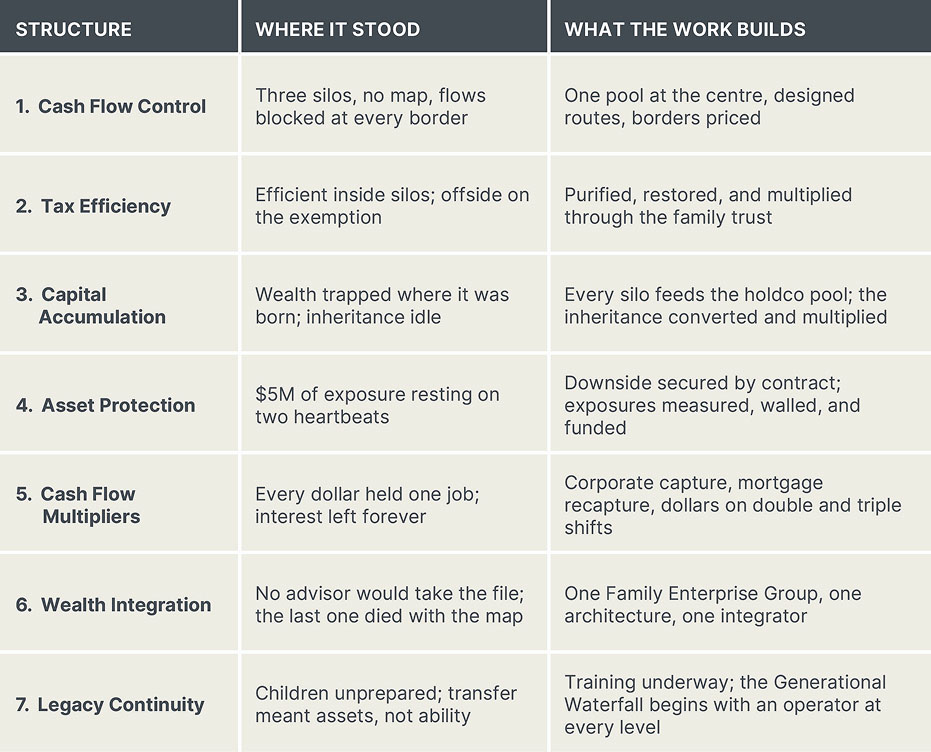
Here is what the industry walked past. Each silo was tax efficient on its own. But the money was trapped. Profit could not circulate between the operating company, the real estate company, and the household without triggering tax at every border. Both parents carried the full concentration risk personally.
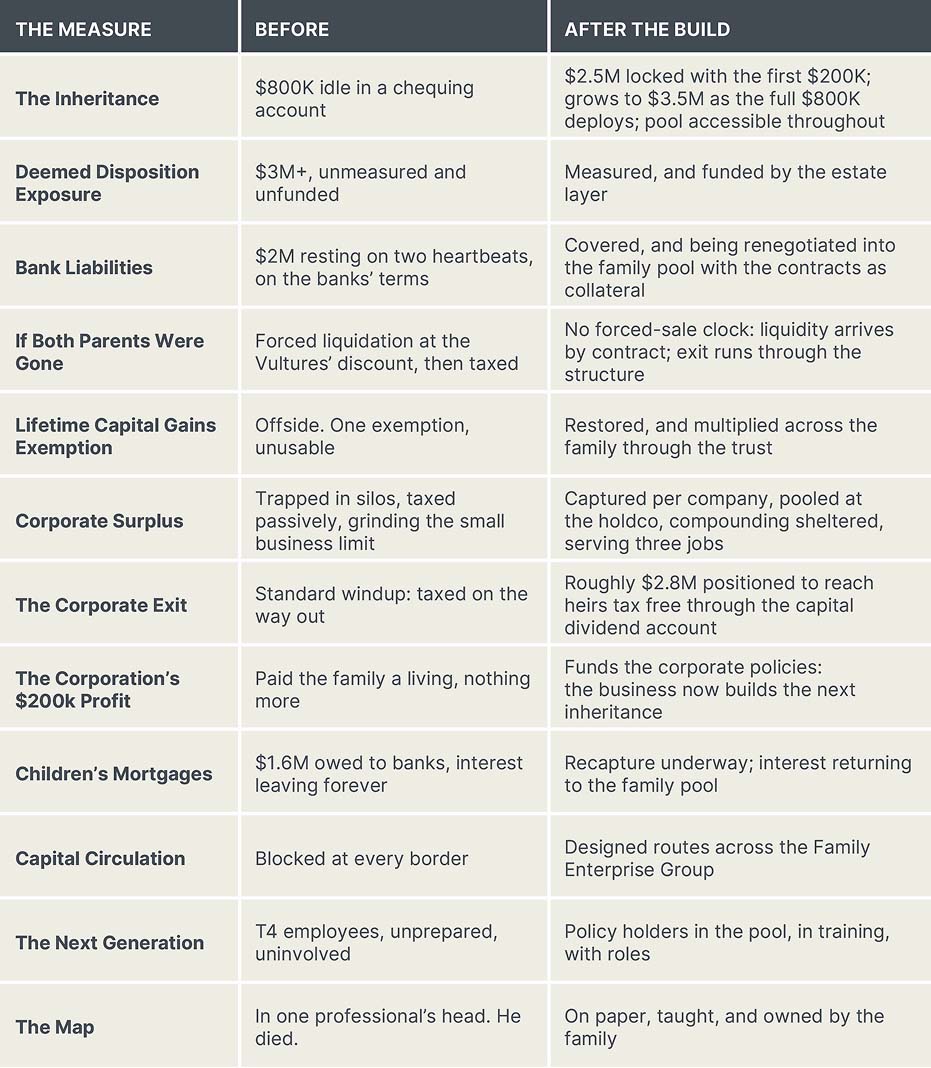
When we ran the numbers: $3M+ deemed disposition exposure. $2M of bank liabilities across the group. Unfunded. Unmeasured. Resting entirely on two heartbeats. And the lifetime capital gains exemption — the single largest tax shelter a business family in Canada has — was offside.
Then Paul’s parents passed, and $800,000 of their life savings landed in his chequing account. The most careful man his children knew now had his inheritance sitting in cash.
The diagnostic put the two invisible numbers on one page. Nothing about this family was fine. Nothing about this family was broken. It was simply unbuilt.
SECTION 02 · THE NUMBERS
Before And After, On One Page.
The same dollars. Rerouted.
SECTION 03 · THE BUILD
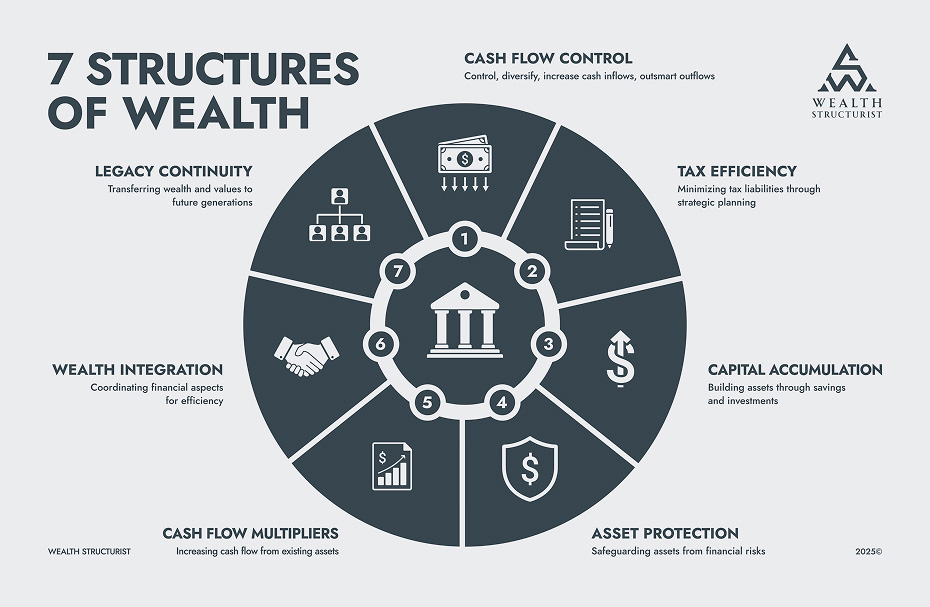
Seven Structures. One Family Enterprise.
The Foundation — A Centralized Family Pool of Capital
Before any structure got retooled, the family needed a centre. The $800,000 inheritance became the seed. Directed into a personally owned participating whole life policy at $100,000 a year, the sequence did something most families never see: two years and $200,000 in, the policy had already locked in a $2.5 million transfer. A quarter of the inheritance secured three times the whole of it. As the remaining $600,000 flows in, the secured amount grows to roughly $3.5 million. The cash value stays accessible the entire time.
$200K in locks $2.5M. The full $800K grows it to $3.5M. The multiplication is the point — the access is the mechanism.
SECTION 04 · THE DIAGNOSTIC
Where Each Structure Stood. Where It Stands Now.
SECTION 05 · THE TAKEAWAY
The Industry Saw Nothing To Manage. That Was The Correct Read Of The Wrong Question.
Nothing about Paul’s business changed. The shop still runs, the buildings still collect rent, the profits are the same profits. What changed is that the family stopped being a collection of tax-efficient strangers and became an enterprise.
There are thousands of operators exactly like Paul — doing fine by every measure except the one nobody is scoped to check: whether any of it holds together, and whether any of it survives them.
Structure creates wealth. Wealth does not create structure.
Paul’s parents proved the first half with forty years of work and an $800,000 legacy. Paul proved the second half in two years: $2.5M locked with the first $200K. A path to $3.5M. $2.8M positioned to leave the corporate group tax free. And a family learning to run the waterfall it now stands at the top of.
The question was never what Paul had to invest. It was what Paul had to build.